
In 2017 I entered the Mslexia Poetry Pamphlet Competition. The collection was called ‘The Birdwatchers’ Year’ and whilst I didn’t win the competition, the pamphlet was one of 25 shortlisted by the judge, Amy Wack of Seren Press.
There were 20 poems in the pamphlet – linked by birds and birdwatching. It was a roughly chronological sequence taking the reader from New Year’s Day on the Fens through spring in Wales and autumn in West Yorkshire.
Here I share three poems from the collection.
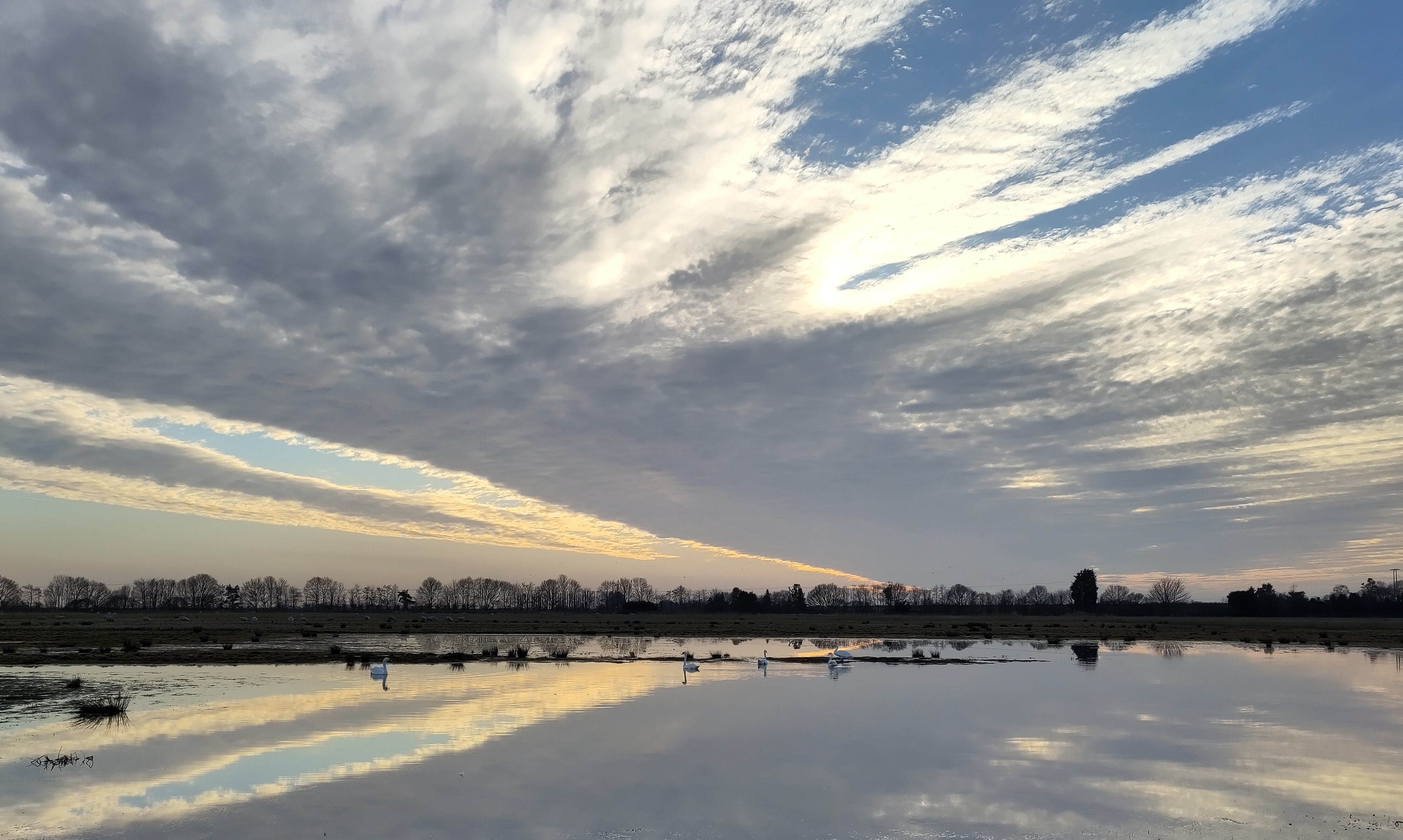
Welney is a nature reserve run by the WWT. I’ve written about its importance as a wetland habitat elsewhere on this site but my poem aims to capture something of the experience of watching a barn owl hunting in reclaimed farmland at dusk. The header image for this post shows Lady Fen which was arable farmland, before being turned into wet grassland by the Wildfowl and Wetland Trust (WWT) who run Welney, and the Environment Agency.
Welney
The year has turned and the wide
fenlands are fire-like in the low
winter sun, glowing red and gold
against the enveloping pure
blueness of sky and water.
As the light begins to droop
and fade, first day about to turn
into first night, a barn owl shaped
silence falls which follows
the boundaries of the field,
setting the limits of the year ahead.

This poem is set at the top of an iron age hillfort in Wales. It recalls a shared moment of quiet intimacy set against the backdrop of the natural world, with birds and mountains, where the sense of Communion was an unexpected gift.
On Mynydd Illtud Common
It was a walk through a bed of skylarks
with red kite overhead and the wheatears
come early into the glow of gorse.
A yellowhammer sang out
‘a little bit of bread and no cheese,’
calling us to share, and at the summit
of Twyn y Gaer there was a breaking,
not of bread, but of chocolate, eaten
in an untroubled and awestruck silence.
A communion of sorts.

As a teenager I lived near enough to Haworth to be a regular visitor and its mix of history, literature and landscape has always been potent. An ordinary West Yorkshire mill village elevated to pilgrimage site. A churchyard packed full of graves because of poor living conditions. Bustling streets and empty moors. Remote yet connected to the world by packhorse trails leading to ports and by translated words.
The churchyard, St Michael and All Angels, Haworth
A soon to be disappointed tourist examines
the inscriptions, looking for what isn’t there,
eventually giving up and taking the path
towards the heather, which is turning a
consoling purple in the September sun.
Meanwhile, chickens wander unchecked,
scrabbling through twigs and fallen leaves.
The chicks, now past the ball of fluff stage,
still stay close to their parent and seek
sanctuary between the leaning slabs.
I like this ordinariness in a place deemed
to be sacrosanct twice over, a gateway
between village and moor, church and parsonage,
the living and the dead; where pilgrims flock.
But then I catch myself wondering – did
the Brontës have anything to say about
chickens? – and conclude that I have stood
long enough amongst this puzzle of graves.

 Shelly Dennison
3 Comments