
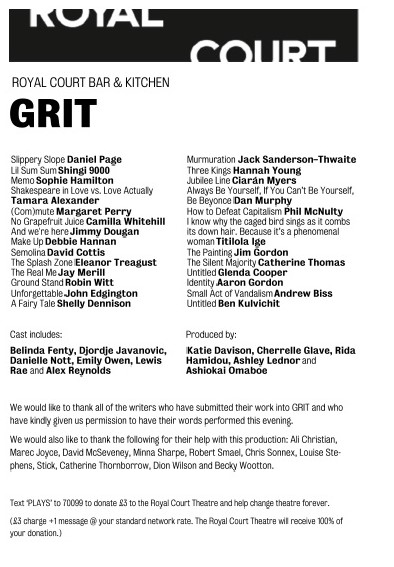
Back in 2015 The Royal Court Theatre in London put out a call for short pieces inspired by the themes of resistance, revolution and defiance. A selection of those tiny plays, including mine, were performed as rehearsed readings.
My play was inspired by the public outcry against the government’s proposals to sell off some of their forest estates.
I have always been drawn to forests and woodlands as places to walk and explore but there were a number of other influences that came to bear in writing my piece.
Stories and fairy tales
A very high number of children’s books and stories are set in forests. Sara Maitland’s Gossip from the Forest is a very good exploration of some of the links between fairy tales and forests. A trawl through my own childhood reading gave me a list which runs from Danny The Champion of the World through Winnie-the-Pooh, The Wind in the Willows, The Sword in the Stone, The Lion, The Witch and The Wardrobe, The Hobbit to Jemima Puddleduck. It’s the classic structure of fairy tales which provides the framework for a monologue where the speaker tries out different ways of telling the same story. It’s also, in part, about how stories work and their power.
Robin Hood
Robin Hood is one of our most famous forest dwellers, in popular myth an outlaw who robbed the rich to give to the poor and yet my narrator asks ‘was Robin Hood a good guy or a bad guy?’ As part of my history course at university I took a module on heroes – this was a comparative special subject looking at heroes across a broad timespan and asking what makes a hero a hero? Robin Hood is an interesting case in point. Was he real – and does it matter? In what circumstances do outlaws become heroes – is it when they reflect a deep dissatisfaction with the legal system, the economic situation or political unease? In the earlier sources for Robin Hood there is little evidence of him giving to the poor but he did oppose poor justice systems and exploitation and in doing do became a folk hero. The forest backdrop provides a place where he and his supporters could escape the usual codes for society in the Medieval period and where, in theory, Robin Hood could become almost invisible and invulnerable. The geography of the stories might be vague but Sherwood Forest takes on a very concrete form as a place that comes to represent both freedom and belonging.
Forests and their histories
A second university course that fed into this piece was on the medieval English countryside. In particular the histories of rural and forest trades and industries. My character is deliberately named Fletch in an echo of fletchers and fletching – the making and selling of arrows. (Of course this also resonates with the stories of Robin Hood as champion archer) Forests have long been managed by humans to provide food, firewood and other raw materials. Woodland industries included charcoal manufacture, mining, timber production, lime, hunting, building, leather working, carpentry, blacksmiths, barrel making, rope making, glass making, pottery and trapping. They were places to be managed through coppicing, provided grazing and fuel. This was small scale industry supporting the local economy and adding to income from agriculture. Craftsmen had small holdings and would have done other work on a seasonal basis. The wood was used to build roofs, walls, wharfs, vehicles, boats, tools for agriculture, industry and war, furniture and buildings. As Fletch says, people relied on the forests for their day to day existence.
The question at the back of my mind was what are forests needed for now? What do they give us that prompted the public outcry? Is it green places to escape? Is it the stories they guard? Is it the history they encapsulate?
If we lost the forests would we lose the stories?
GRIT – A FAIRY TALE
By Shelly Dennison
A deciduous forest in England. It is summer; dappled light and birdsong.
FLETCH:
Once upon a time there was a government who decided to try and flog the nation’s forests to make a quick buck.
Pause.
Try again.
Pause.
Once upon a time, a greedy king sat alone in his magnificent castle. One day decided to raise yet more gold by selling off the forests. However, his people not only loved to walk in them but relied on them for firewood and food.
Pause.
Once upon a time, there was a forest in every good story. Wild Woods, enchantments, outlaws, wolves, red cloaks and gingerbread houses. If we lost the forests would we lose the stories? The trouble with stories though, is that they’re slippery. Take badgers. Wise old men of the woods or vicious, TB carrying vermin quite capable of ‘moving the goalposts?’ Was Robin Hood a good guy or a bad guy? I don’t know.
Pause.
Fairy stories always end with a moral, so how about – tell stories, change the world? They don’t even need to be gritty.
Pause.
So the people banded together and made their protests heard. The king had no choice but to give in because he feared for his crown.
Pause. Then very clearly and firmly.
And they all lived happily ever after. The End.
Pause. Then less certainly.
Maybe. Who knows?

 Shelly Dennison
1 Comment