
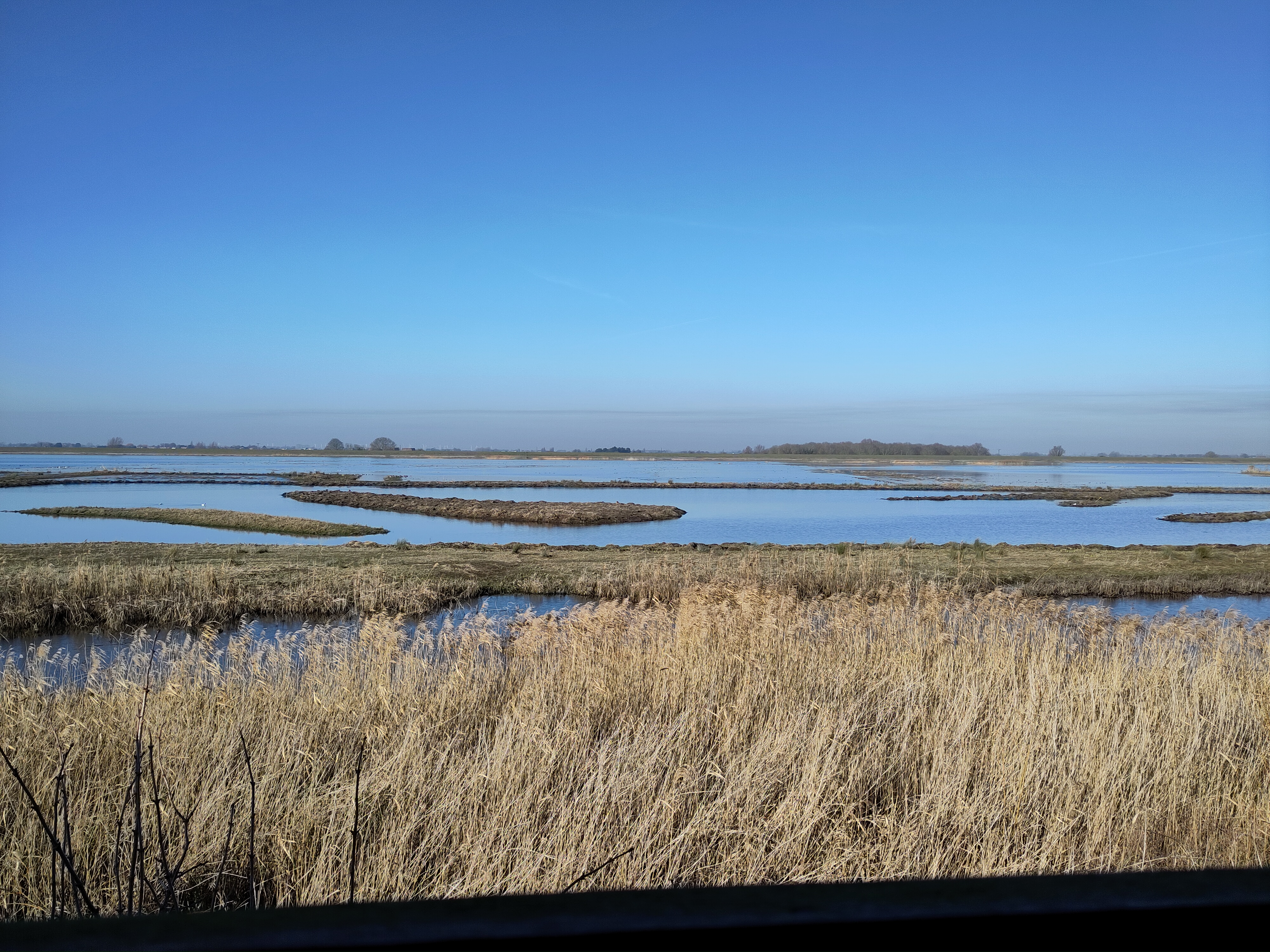
It’s a clear morning in early February, there’s a tang of cold and salt in the air. A shimmering flock of black-tailed godwits lifts off from the flooded meadows. The view from the hide is blue as far as the horizon with its wind turbines, broken only by golden reed beds and islands of higher ground.
I’m at the Welney Wetland Centre in Norfolk, ten miles north of the city of Ely, whose magnificent cathedral dominates the flat fenland landscape. Follow the river Great Ouse further north and it’s not far, as the eels that gave their name to the city swim, before it meets the North Sea at Kings Lynn.
Like many people I’m drawn here by the promise of a spectacle – large flocks of Whooper and Bewick’s swans overwinter here. Spectacles also come in smaller packages. A marsh harrier flies low over a reed bed, lapwings with their distinctive spiky crest let out their pee-wit call, the first returning avocet of the season stands alone in a crowd of black-tailed godwit, a kestrel fixes eyes on a kill, a barn owl makes an appearance over the soggy fields as the light began to fade. There’s always something to see.
At the end of the day, as I get ready to head for home, I’m more relaxed than I’ve been in a long time.
This realisation got me thinking – how much is a landscape like the Ouse Washes worth? For me and my wellbeing it was clearly time well spent, but what else can be said? Is it possible to begin to measure the value of a wetland habitat like this one?
Wetlands are areas of land that are either permanently or seasonally inundated with water, for example heavy winter rain swelling streams and rivers to the point where they eventually burst into the surrounding landscape. They support a wide range of life that is often specially adapted to live there. They’re places that can change with the seasons or the tides. They’re also places under threat. Land can be drained for farming or building; water can be polluted and climate change can leave them dry and degraded.
Welney covers a thousand acres of the Ouse Washes. These man-made flood plains of the river Great Ouse were created by engineers in the seventeenth century to protect the low lying fens from flooding. The fertile reclaimed land could then be used for farming. Today they are Britain’s largest area of seasonally-flooded land, providing a rich source of food for migrating birds in the winter.
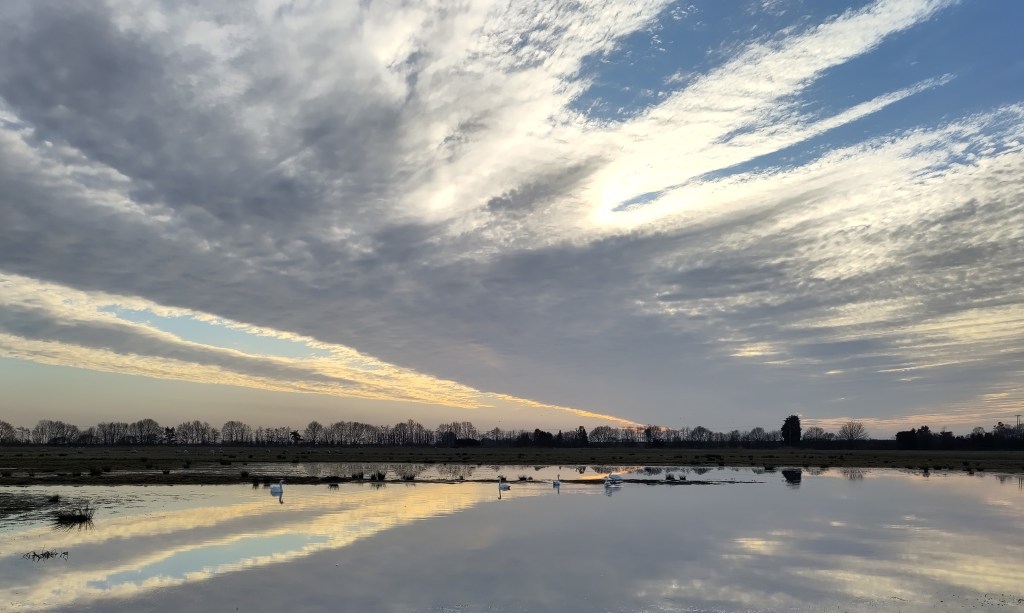
Welney is also home to Lady Fen, which was arable farmland, before being turned into wet grassland by the Wildfowl and Wetland Trust (WWT) who run Welney, and the Environment Agency. They added features including permanent ponds, hollows which can become temporary ponds, and networks of ditches. Late in the afternoon of my visit, the still pools are mirrors of the wide fenland skies, while swans investigate the clumps of grass at the water’s edge and flocks of starlings dance as one overhead.
The UK’s wet grasslands provide an excellent habitat for breeding waders, such as lapwings and black-tailed godwit. These are ground-nesting birds, their young feed on the invertebrates that live in the soft damp soils, ditches and ponds. The wet grasslands are crucial for the survival of many species of these breeding and overwintering birds. Bees, butterflies, moths and pollinating insects find valuable pollen and nectar in the flowering plants, rushes, sedges and grasses. These temporary wet areas are also important for dragonflies, water voles and amphibians, which in turn attract predators such as grass snakes.
The black-tailed godwit is one of Welney’s flagship species. The birds are facing many challenges including the draining of habitat for farmland. This changing landscape can confuse the returning birds who struggle to find their partner. Hatchlings drowning in rising flood waters is another risk as climate change leads to changing patterns of flooding and a higher volume of flood water. The power of this flood water can lead to eggs being smashed. The eggs are also vulnerable to being eaten by predators. In the last 25 years almost half of Europe’s black-tailed godwits have been lost.
Enter Project Godwit, a partnership between the WWT and the RSPB. This conservation programme concentrated on the Ouse Washes and the Nene Washes in neighbouring Cambridgeshire. In 2017 there were only three pairs of black-tailed godwits left on the Ouse Washes and the population on the Nene Washes was in decline. These birds mate for life, returning to the same wetland to rest, overwinter and lay eggs each year, so habitat conservation and restoration is crucial. The landscape and the lives of the birds are entwined. The project has created shallow ponds, known as scrapes, which hold rain or flood water seasonally and stay damp for most of the year, across its sites. Widened ditches and new fences and gates keep predators at bay.
A second strand to the programme is headstarting. This involves collecting eggs (under licence), rearing the chicks in captivity and then releasing them shortly after they fledge. Lady Fen at Welney is a key location for the release of the small, and still vulnerable, fluffy chicks.
The initial results from the monitoring and research programme are promising and chick numbers are increasing. However, the number of chicks hatching in the wild remains low meaning that population growth still relies on intensive human intervention through the headstarting work. More wet grassland which is safe from spring and summer flooding is needed so that the chicks can be raised without the risk of drowning. The existence of that shimmering flock of black-tailed godwits means more than I’d appreciated at the time of my trip, a form of witness to survival against the odds.
As the light slowly starts to fade at the end of my visit, I watch a group of whooper swans flying over Lady Fen, keeping their graceful long necks in sight through my binoculars as they head towards the Ouse Washes. Their migration brings them from Iceland via a long sea crossing to the feeding grounds of East Anglia. The patterns on their yellow and black beaks are a unique fingerprint, allowing scientists to monitor each individual. Humans tend to place ourselves at the centre of everything but I couldn’t help but wonder, what is this wetland worth to this group of swans? What is it worth to the black-tailed godwit chicks released on to the fen?
These kind of questions are impossible to answer but at least I could feel like I’d had a day out that makes a difference to the birds. The money spent on entry fees and in the cafe is used to help fund a range of services including education programmes, habitat restoration and conservation work.
This positive feeling brings me back to my earlier realisation that a day spent at Welney had been good for my wellbeing.
It turns out that I’m not alone in finding being around this tranquil blueness good for my stress levels. A growing number of studies are showing a clear correlation between time spent in nature and improved health. This has in turn led to a rise in nature prescribing or green social prescribing which links patients to a range of programmes based around nature, growing projects and walk for health initiatives. A green prescription can be given by a range of health and social care professionals including GPs, physiotherapists and community mental health practitioners. They can be used to tackle a range of conditions, both physical and mental.
In 2019 the WWT ran a pilot project at their Slimbridge reserve on the Severn Estuary in Gloucestershire. Participants spent two hours a week for six weeks taking part in a range of activities including birdwatching, an estuary walk and a canoe safari. The pilot used questionnaires, interviews and focus groups to assess the project’s impact. When the researchers compared the data from the start and end of the project they could see clear improvements across a range of indicators. The opportunities for socialising had reduced loneliness and helped the participants to feel part of a community. People who had been referred to the project with anxiety or stress benefited from time in tranquil, wildlife rich spaces. There were opportunities for guided physical activities which gave participants more confidence in their ability to take part in outdoor exercise. Two years later the WWT started a Blue Prescribing project at the London Wetland Centre. Through nature prescribing, citizen science projects and volunteering opportunities they helped people connect to natural spaces in an urban environment. As with the Slimbridge pilot they found that the opportunities helped to foster a sense of belonging and provided physical and mental health benefits.
Physical and mental health are closely related, increased activity can help manage and prevent a number of chronic conditions including depression, anxiety, asthma, heart conditions and obesity, saving the NHS money and time. Figures suggest that around 1 in 4 people in England experience poor mental health each year, accounting for around 40% of GP appointments. Mental health conditions cost the NHS an estimated £34 billion per year with the wider economic, social and health costs amounting to £105bn a year. Fewer visits to GPs, less expensive or invasive treatment programmes and better health outcomes might be ways of measuring how much a wetland might be worth.
The health benefits of wetlands are great news for individuals and communities, and they’re not the only positive story.
Wet grasslands play a valuable role in water storage, protecting homes and businesses from flooding. At the National Trust’s Wicken Fen, just over the border in Cambridgeshire, arable land has been restored to fenland and part of the site converted to a flood storage area. This protects around 53 homes and 50 hectares of farmland. This provides flood protection benefits worth £35 per hectare per year. Natural methods of flood prevention are often more cost effective than schemes like barriers and come with a range of extra benefits like increased biodiversity.
Wetlands can help protect us from surface water flooding during rain storms. They soak up excess rainfall and slow the flow of water, which reduces surges in water levels. This not only reduces the risk of houses flooding and avoids clean-up costs, but alleviates the mental stress people suffer during floods.
A poster in the main hide at Welney shows visitors something perhaps more surprising about wetlands. They also help regulate the climate, acting as carbon sinks. This means they absorb more carbon from the atmosphere than they release. As wetlands are damaged and degraded, they begin to release stored carbon, making their restoration, creation and protection an important nature based solution to climate change. Improving the habitat of Lady Fen to turn it into flower rich wet grassland means it will capture more carbon.
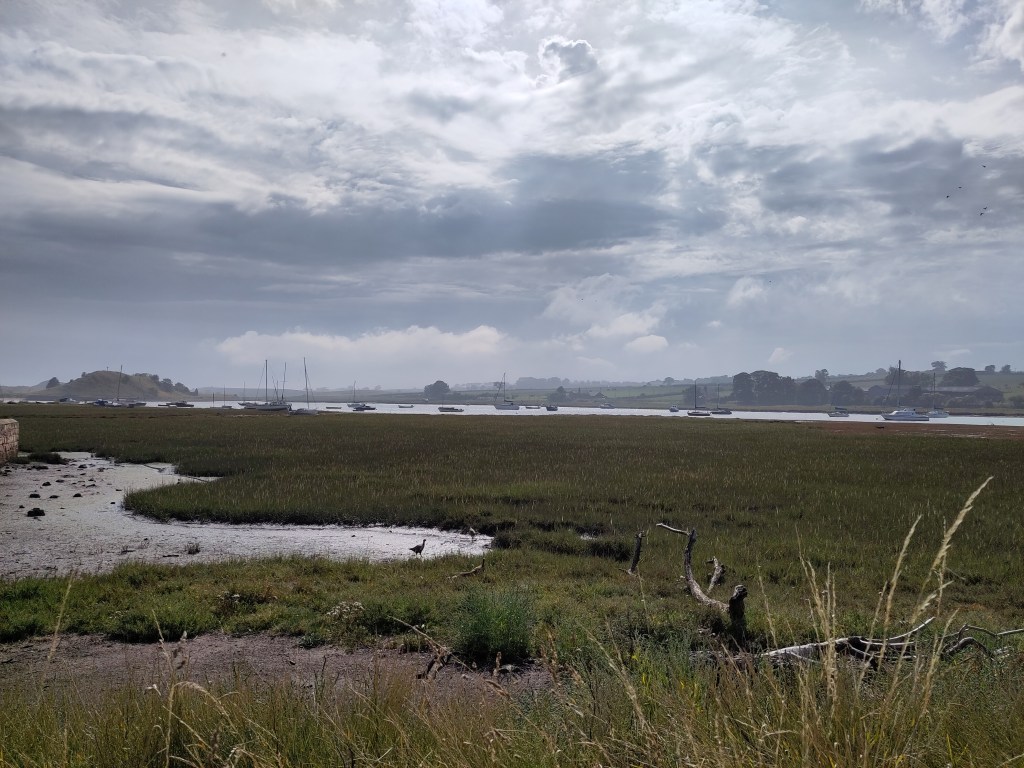
A few months before my trip to Welney, on holiday in Northumberland, I visited the coastal village of Alnmouth with its salt marshes and sand dunes. Pheasants and lapwings were enjoying the rich feeding grounds of the marshes. A barn owl quartered around a nearby field, hunting for mice or voles. Salt marshes are important wetland habitats for a whole range of species including birds, fish and specialist salt tolerant plants. They are also one of the greatest carbon sinks we have in the UK. Salt marsh plants capture carbon dioxide, locking away carbon inside their leaves, stems and roots. As they die the captured carbon is buried and stored in the soil. Wet mud, which contains more plant remains and therefore carbon, comes in with the tide and is trapped by salt marsh plants.
At the WWT’s Steart Marshes in Somerset, reclaimed farmland is now home to locally produced salt marsh lamb and beef, with sustainable commercial fish nurseries found in the creeks and shallows. Supporting local economies through high quality sustainable food production is therefore another surprising benefit of well managed wetlands.
Wetlands are complicated places. It’s no great surprise that precisely pinning down their worth turns out to be complicated too. Different people will have different stories to tell about them, from birdwatchers to farmers, patients to conservationists. They will measure worth in different ways, from the economic to the emotional. Whether we value wetlands for their rich biodiversity, positive health benefits or flood protection, they are undoubtedly fascinating places. It’s worth spending some time getting to know them better.
This article came out of a writing exercise in the Popular Science Writing course run by the University of Cambridge Institute of Continuing Education. The course was both enjoyable and useful, and I’d like to thank our tutor, Dr Helen Scales, and the other students for comments on earlier drafts.

 Shelly Dennison
2 Comments