
Biography of a wood
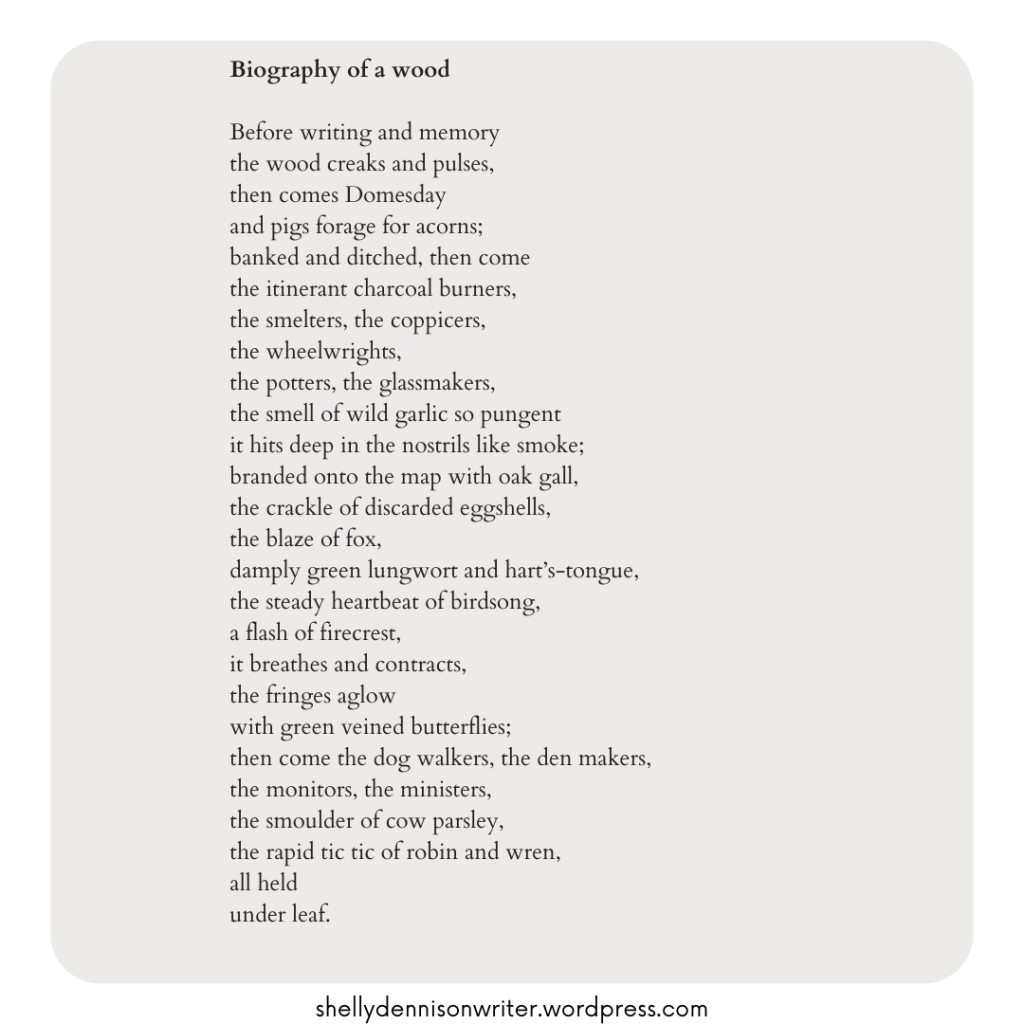
My starting point for this poem was the idea of ancient woodland. In England, areas of woodland that have persisted since 1600 are defined as ancient woodland. 1600 is the date at which maps became more accurate and reliable so we can be confident that the area has been woodland for at least that amount of time. However, extant woodlands can be much older than that, with many able to trace their roots back to at least the Domesday Book of 1086. A common way of recording the economic value of a woodland in Domesday was to account for how many grazing swine it could support. The idea of a pre-human wildwood is one that resonates deeply with many people, it has a mythic quality about it.
The poem is a canter through history, it takes some of the ways that we have interacted with woodlands and combines them with images from the natural world. The first draft came quite quickly after a few days of notes and word gathering. I was particularly interested in finding words that were about burning and fire, and words that were about breath and blood.
It feels rather different to other poems I wrote at around the same time, faster paced, a bit more rhythmic and full of energy, which was an interesting development. The imagery is more fragmented than my usual approach to storytelling but I hope it builds to a kind of story or biography.
*****
You might also like my post Grit – fairy tales and forests. Back in 2015 The Royal Court Theatre in London put out a call for short pieces inspired by the themes of resistance, revolution and defiance. A selection of those tiny plays, including mine, were performed as rehearsed readings.
My play was inspired by the public outcry against the government’s proposals to sell off some of their forest estates. You can read more about it by following the link above.

 Shelly Dennison
1 Comment