
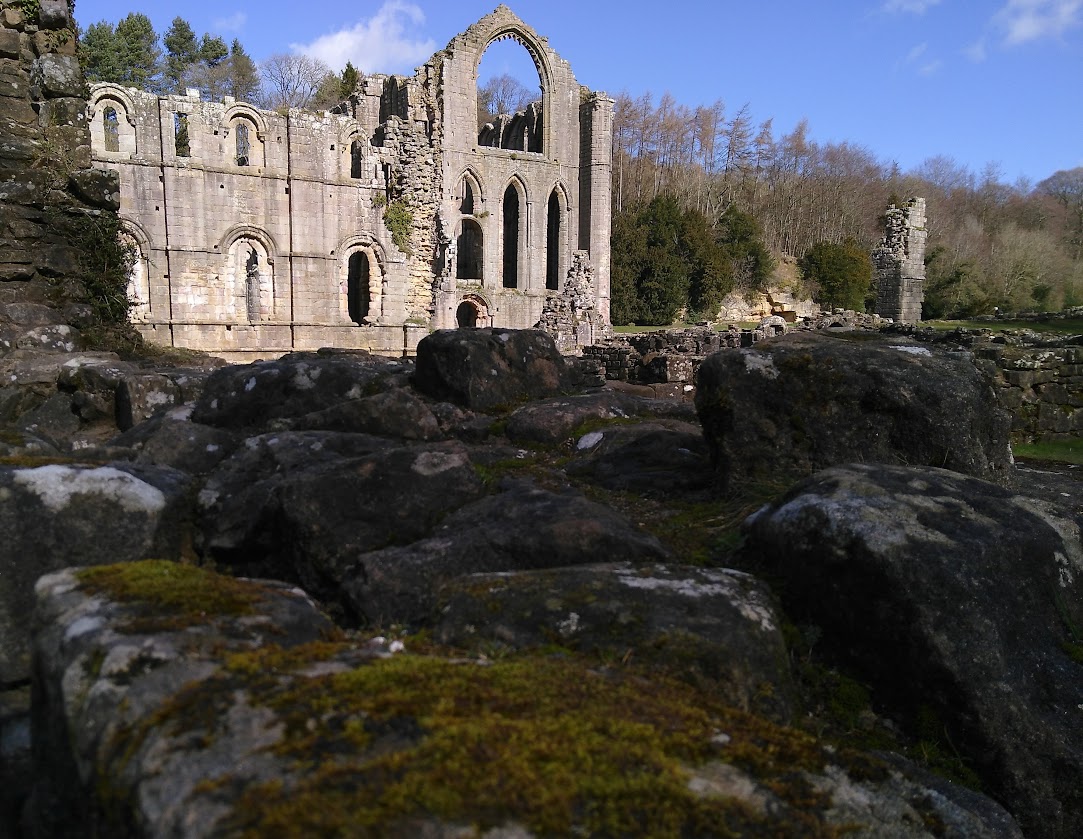
The first glimpses of the ruins of Fountains Abbey are fleeting, spied through the trees that line the steep valley. As the modern pilgrim descends, the path winds its way towards the Porter’s Lodge, once the gateway to the great abbey. The impressive monastic complex then opens up ahead with an invitation to repopulate this remote spot with imagined monks and lay brothers, a mill, a tannery, a malt house and the handful of farms, known as granges, that served the abbey.
As a Cistercian house, it was founded on the principles of adherence to a strict life of prayer and self sufficiency. The buildings were designed to serve these purposes, from a church, chapter house and cloister, to an infirmary, kitchens and bakehouse. Fountains Abbey is famous for having grown rich through sheep farming and the selling of wool but other commercial interests included timber, mining, quarrying, iron smelting, fishing and milling. Twenty five miles away to the north east, in another remote Yorkshire spot, stood Rievaulx Abbey, another Cistercian foundation. Like Fountains Abbey it derived income from mining – in this case, lead and iron ore – and wool.
Monks from Fountains and Rievaulx travelled 180 miles south to found abbeys in Bedfordshire. The journey would probably have followed the route of Ermine Street, today’s A1. If they were on horseback, they would have expected to cover 10-15 miles per day, perhaps up to 30 in the summer months, so the journey could have taken around three weeks to complete. They would have seen the landscape change from the wooded valleys and moorland of North Yorkshire to the flatter plains of Lincolnshire and beyond. Bedfordshire’s Greensand Ridge with its woodland, heathland and pasture might have felt reassuringly familiar, if rather less dramatic in scale, to the travellers.
Warden (or Wardon) Abbey was founded in 1135 by Walter Espec, the lord of the manor. It was initially home to an abbot and 12 monks from Rievaulx. Woburn Abbey was founded ten years later by Hugh de Bolebec and monks from Fountains. The two abbeys were less than 20 miles apart. The sandy, acidic soils of the Greensand Ridge made it difficult to grow crops so the area was only sparsely populated.
Nothing remains of the original monastic buildings above ground at either site. Woburn Abbey survived until 1538 when it was dissolved by Henry VIII. In 1547 it became the property of the Russell family, the Earls (later Dukes) of Bedford. The original abbey buildings were demolished in around 1630 and a new manor house was built. The imposing house we see today was built in the eighteenth century.
At Warden Abbey the self-sufficient holdings included two vineyards, pasture, gardens, fish ponds, orchards, beehives, mills, dovecotes and farms. Like the northern monasteries, Warden sold wool to merchants from Italy, Flanders and France. In the twelfth century it managed 22 granges and 13 mills, which supported the monastic community. The abbey was surrendered to the Crown in 1537 during the Reformation. In 1545 the site was acquired by Robert Gostwick who built a red-brick farmhouse next to the site of the former abbey church. The building was demolished in the late eighteenth century and the site bought by the Whitbread family.
The lack of impressive ruins like those at Fountains or Rievaulx can feel like a blow.[1] It is harder to repopulate the parkland at Woburn or the farmland around the village of Old Warden with imposing church buildings, self sufficient communities and prayerful routines. For the monks, each day revolved around fixed periods of prayer, interspersed with manual labour and spiritual reading. Lay brothers attended fewer services and did more manual work, their rhythms perhaps more in tune with the agricultural year than its liturgical counterpart. One of the places they would have spent time was the vineyard.
It is the simple stuff of everyday life that so often helps us to reach back into the past. In the case of Warden Abbey this might be bales of newly shorn wool, grain for bread, beeswax for the candles that would flicker in the church, or grapes. The vineyards at Warden were originally planted by medieval monks.[2] They created a Great Vineyard (possibly about 24 acres) and an adjoining Lyttel Vineyard (just over 16 acres), probably before the end of the 12th century. The wine would have been used in a variety of ways in the monastery, the best wine was kept for services, high ranking clergy and special guests. Other uses included flavouring food, as a preservative, disinfectant, insect repellent and tonic. Wine mixed with water was widely drunk as the alcohol helped to kill bacteria found in water.
Imagine a monk holding a grape between two fingers and contemplating its mottled translucence. This small thing could become for him part of the mystery of the Mass or serve a very practical purpose in the infirmary or kitchen. Did he come from Yorkshire or Bedfordshire though? There’s a question.
1. A painting of Warden Abbey by Peter Dunn used archaeological evidence and the plans of other Cistercian monasteries like Rievaulx and Fountains to create an image of what the complex of buildings might have looked like, and its relationship to the landscape. At 157 acres it would have been one of the largest monasteries in the country.
2. Today the Warden Abbey Community Vineyard is managed by Bedfordshire Rural Communities Charity (BRCC) and is open to the public.

 Shelly Dennison