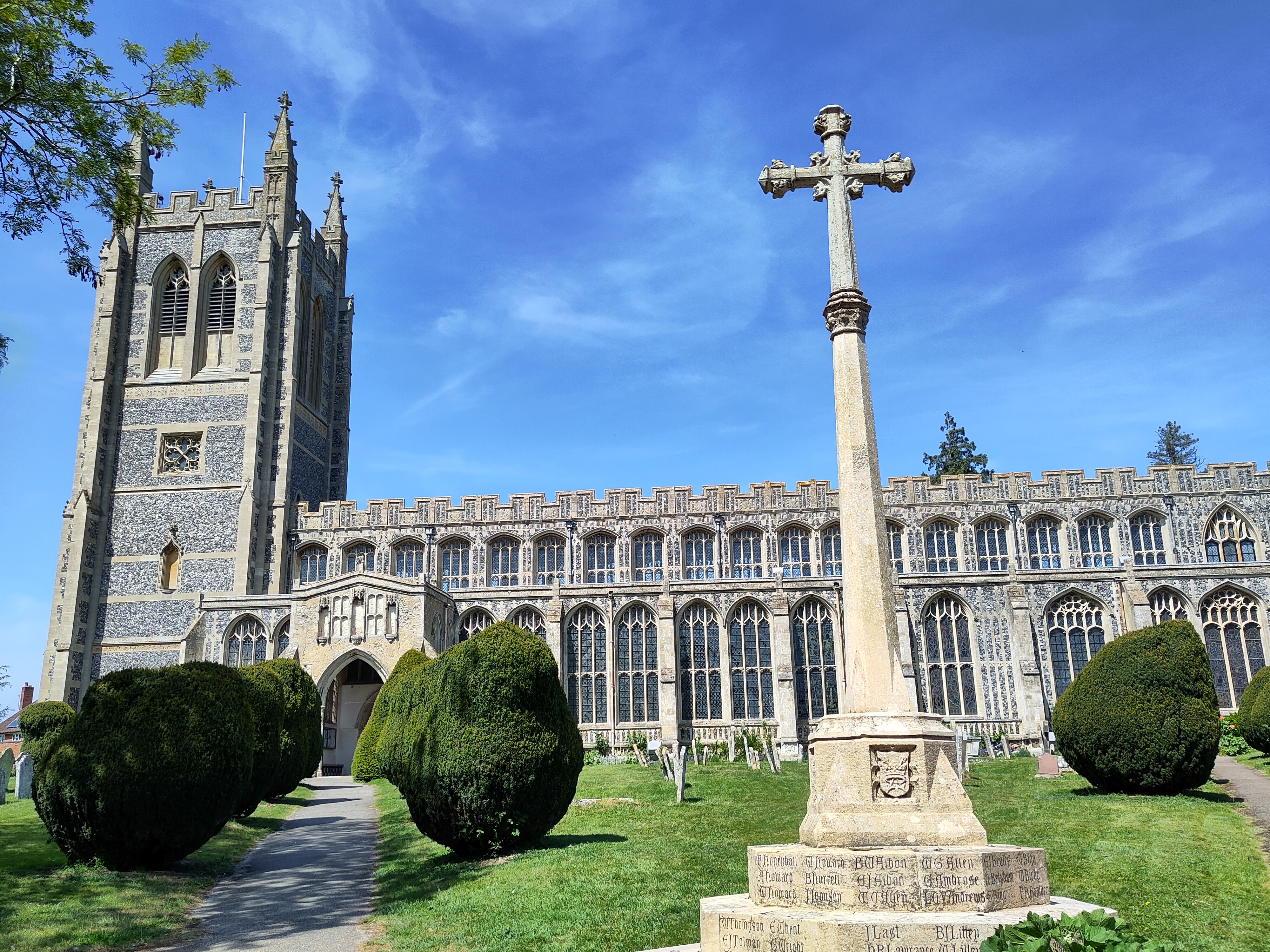
Just before the late Spring Bank Holiday weekend we spent a lovely day in Long Melford in Suffolk. It was rather warm but not yet into the very high temperatures of the weekend heatwave. The main attraction was Melford Hall, a National Trust property that we’d not visited before. In the afternoon we opted for a short stroll up the village green to Holy Trinity Church. This turned out to be an excellent choice. Not only was the church wonderfully cool but it was full of interesting features. Like nearby Lavenham, Holy Trinity is a medieval wool church – one built on the prosperity of the local wool trade. Its founder, John Clopton, was a wealthy cloth merchant.
Unusually for a parish church, Long Melford has a Lady Chapel which is separate from the main church. It’s a surprisingly large space, with an indoor cloister or ambulatory around the perimeter, and vine scroll carving on the timbers. The chapel was used a school in the 17th and 18th centuries and still features a multiplication table on the wall. There’s a nice piece of modern artwork called The Way Through which is by Alison Englefield and really suits the space.

A Lady Chapel is a chapel dedicated to Mary, the mother of Jesus. They became widespread in the 13th and 14th centuries alongside the rise of veneration of the Virgin Mary. In cathedrals and monastic churches they were often separate buildings but in parish churches they usually took the form of side chapels, sometimes with screens to make them feel set apart. Many became associated with the reassurance of women prior to childbirth.
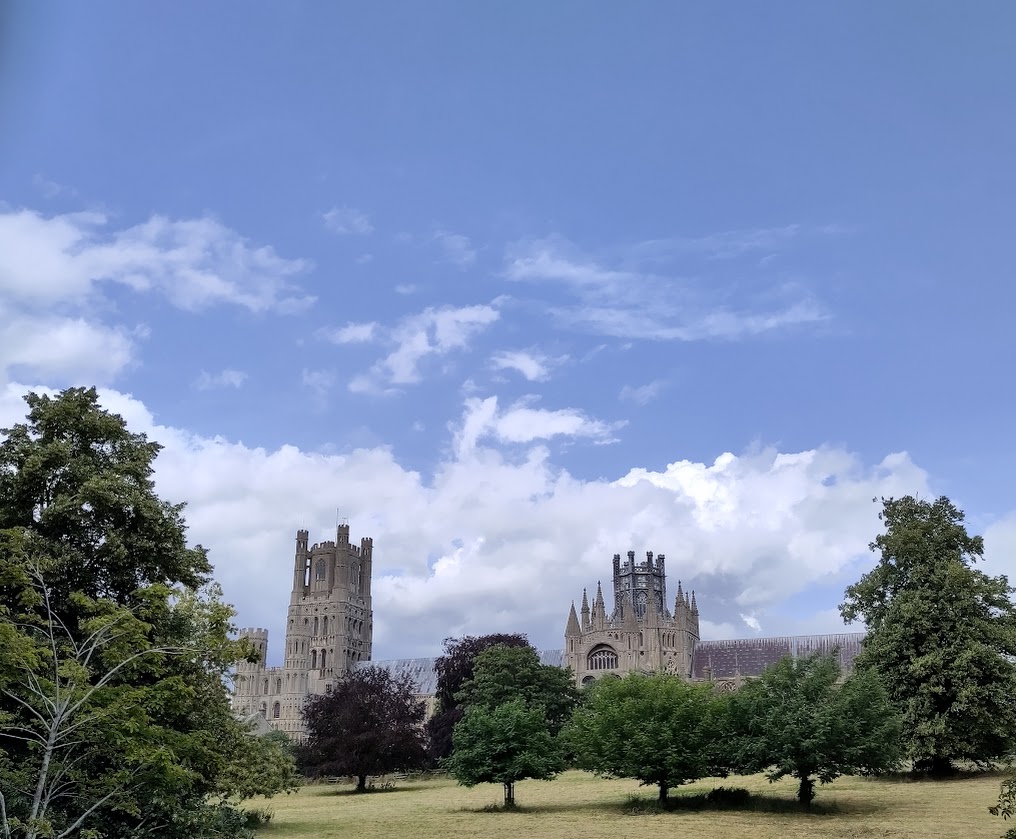
Medieval Lady Chapels were highly decorated, with bright colours, statuary and other images, and stained glass. This meant that they were targeted by iconoclasts during the Reformation, with the features destroyed as the reformers believed them to be idolatrous. The Lady Chapel at Ely Cathedral shows the impact of the upheaval, visitors today can see traces of coloured paint, a few fragments of glass, defaced figures and empty niches where statues would have once stood.
In today’s cathedrals and churches, Lady Chapels are often set aside as places of prayer and contemplation. Here at St Mary’s, the Lady Chapel is formed from the old chancel, after attention moved to the new part of the church following the 1950s extension. The altar frontal uses a medieval rose motif associated with Mary, and she is also depicted on the left hand side of the stained glass window above the altar.

That a trip to Suffolk led to me reflecting on the role of Lady Chapels, both today and in the past, seems fitting as we celebrate our Patronal Festival this month, and look ahead to the 800th anniversary of St Mary’s in 2028. If it’s not a part of the church that you’ve spent much time in, then perhaps the Patronal Festival weekend is the perfect opportunity to take a look.
Originally published in the July 2026 edition of Parish and People, the magazine of St Mary the Virgin, Goldington


