Earlier this month I tagged along on a bellringers outing to Taylor’s Bellfoundry in Loughborough for a tour of the last working bellfoundry in Britain. The site is now managed by the Loughborough Bellfoundry Trust which was set up to protect the buildings as well as the museum and archive collections. I was interested in learning more about this piece of social history and so signed up. This isn’t quite as random as it sounds, my husband is a bellringer and the tower captain at our parish church. I wasn’t the only other half interested enough to join the trip either!
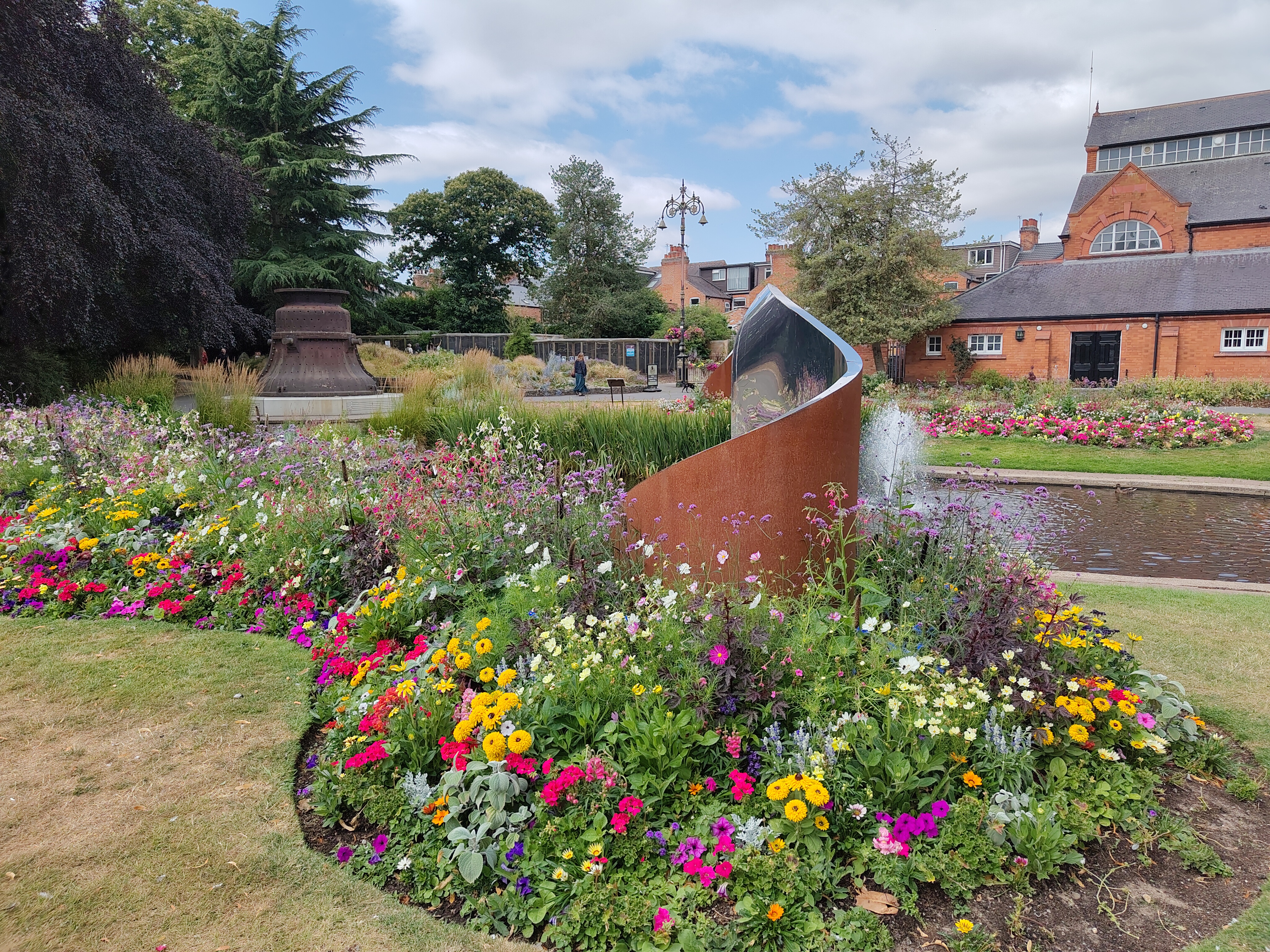
We arrived on a warm sunny morning, negotiated the busy car park, and then stepped into the nearby park where a surprise was waiting. I was immediately struck by the jewel like colours of the planting, the large bug hotel, and the number of bees buzzing around. On a small stream fluffy moorhen chicks were gliding through duckweed
Queen’s Park was opened in 1899 and named in celebration of Queen Victoria’s Diamond Jubilee. The large open urban green spaces that we take for granted today were a Victorian innovation. The rapid growth of towns and industries meant that increasingly people no longer lived within walking distance of the countryside. Campaigners and politicians noted the impacts of this on people’s physical and mental health and began to champion the development of green spaces that could be accessed by workers and their families. Early examples were opened in Liverpool, Halifax, Birmingham and Bristol. The parks were free to enter and were often home to a whole variety of features including sports facilities, ornamental gardens, woodland walks, fountains and statues.
Queen’s Park was no exception and its layout has remained largely unchanged since 1928. Today there are walks, a watercourse with pretty stone bridge, a bandstand dating from 1902, aviaries, a cafe, and a children’s play area. Early in the school summer holidays it was busy and clearly a popular place to meet, play and relax.
The draw of the park was the chance to see the Carillon Tower. A carillon is a set of bells played by a keyboard, struck by clappers operated by a system of levers. They are played by a musician called a carillonneur who chimes the bells using a keyboard called a clavier. The Loughborough Carillon is housed in an impressive red brick tower topped with a copper bell storey.
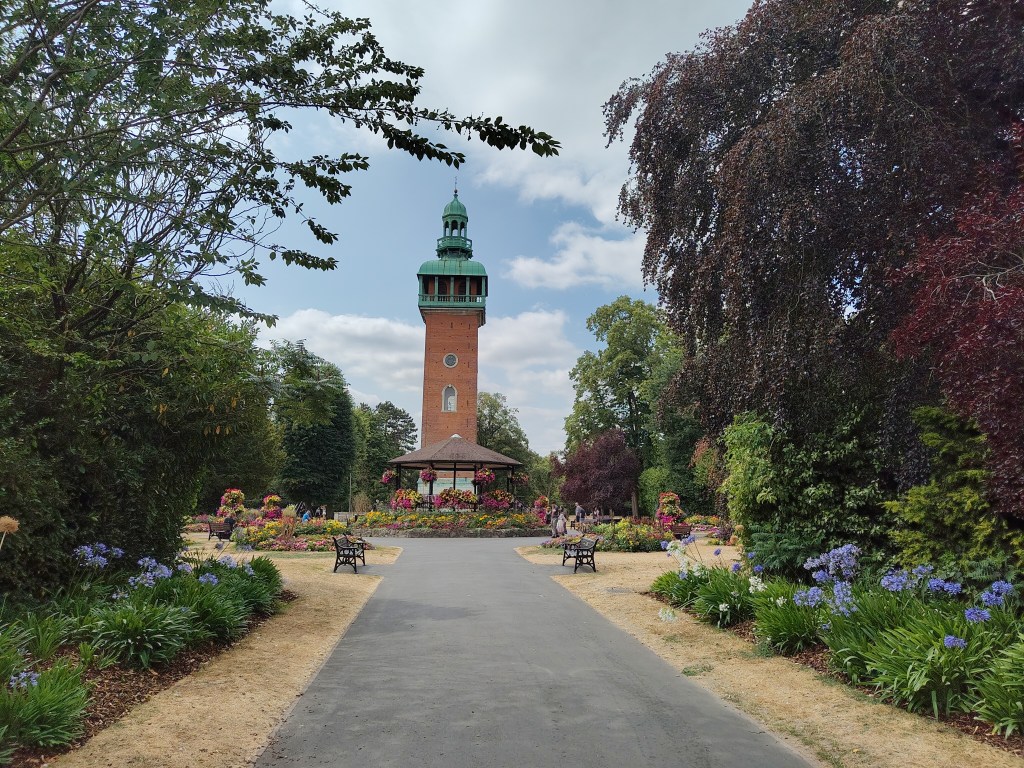
The Carillon is a war memorial dedicated to the men of Loughborough killed in the First World War. It is also home to a War Memorial Museum but this was shut on the day we visited. In 1918 the mayor decided to erect a memorial and in the following year a ballot of the town’s people chose a carillon to reflect the town’s worldwide reputation for bell making. It was unveiled in July 1923. A piece of original music called ‘Memorial Chimes’ was composed by Edward Elgar for the opening of the Carillon. The manuscript, complete with a handwritten note by Elgar, is on display at Charnwood Museum in the park (also closed on the day we visited).
The 47 bells were cast at Taylor’s Bellfoundry. They are all different sizes, each of a different note, and individually tuned. A total of £7,000 was raised for cost of the bells. £2,000 of this came from Taylor’s who paid for the largest bell and the rest came from public subscription and a ‘buy a bell’ campaign which invited individuals and organisations to contribute. Three men from the Taylor family were killed in the war and other companies also wanted to commemorate former employees. During the war bell manufacture had stopped and the foundry turned to manufacturing shell casings, with women stepping in to help. These ‘shell girls’ all lost their jobs when the war ended.
The Carillon Tower is a place of remembrance, a way of preserving local history and of chronicling the impact of war on the community. Just over one hundred years later a second memorial and place of reflection was added to Queen’s Park. The Hope Bell is a tribute to those who lost their lives in the Covid pandemic and a thank you to NHS staff and other key workers who supported the town.
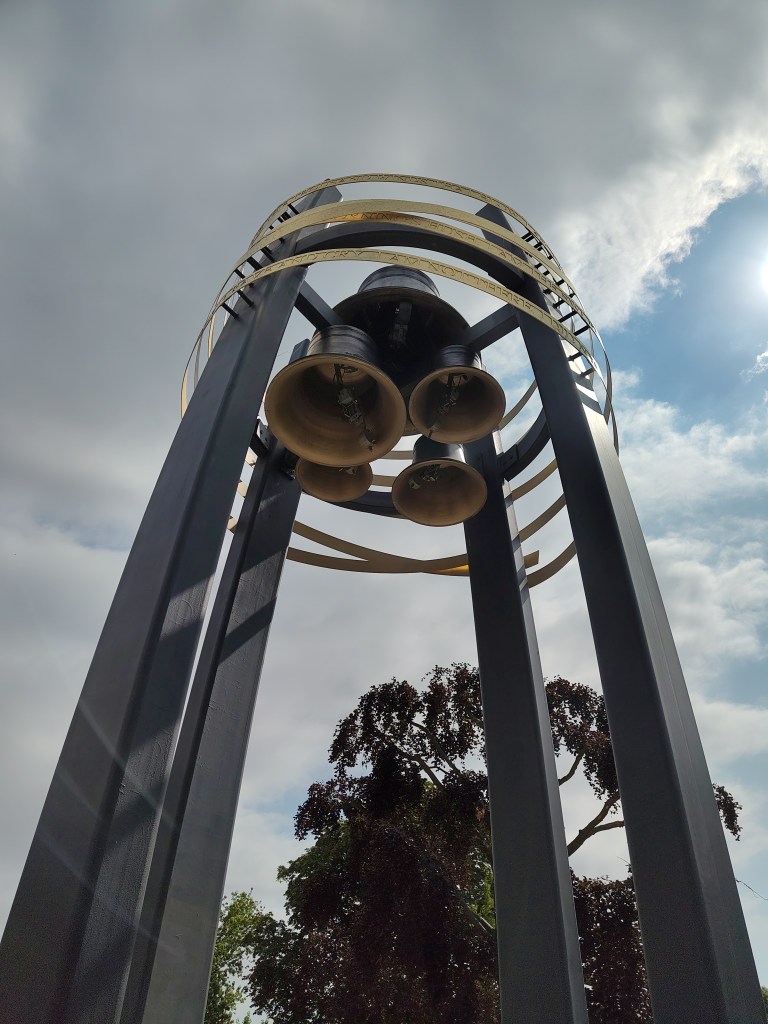
The sculpture has five bells supported by four steel pillars. The clock chime installation is made up of four quarter chime bells plus the main Hope Bell to sound the hours. The pillars symbolise people coming together to embrace in a hug, something forbidden at the time when people were forced apart and yet still supported each other. The bells are encircled by a gold coloured band engraved with the words of Clare Harner’s 1934 poem ‘Do not stand at my grave and weep’. Like the carillon, this focal point for reflection and remembrance was inspired by the town’s bell making heritage, with the bells made by Taylor’s. It was designed and installed by the local Leicester based Vertigo Collective.
The opening ceremony in July 2025 brought together organisations and community groups that had played key roles in the pandemic. The Hope Bell was part of scheme by Charnwood Borough Council to improve the town and act as a beacon of hope for the future. As a symbol of both shared and private griefs, it honours sacrifice in the same way as the Carillon War Memorial. Information boards tell the story behind its creation, and so its story will become part of the story of the town.
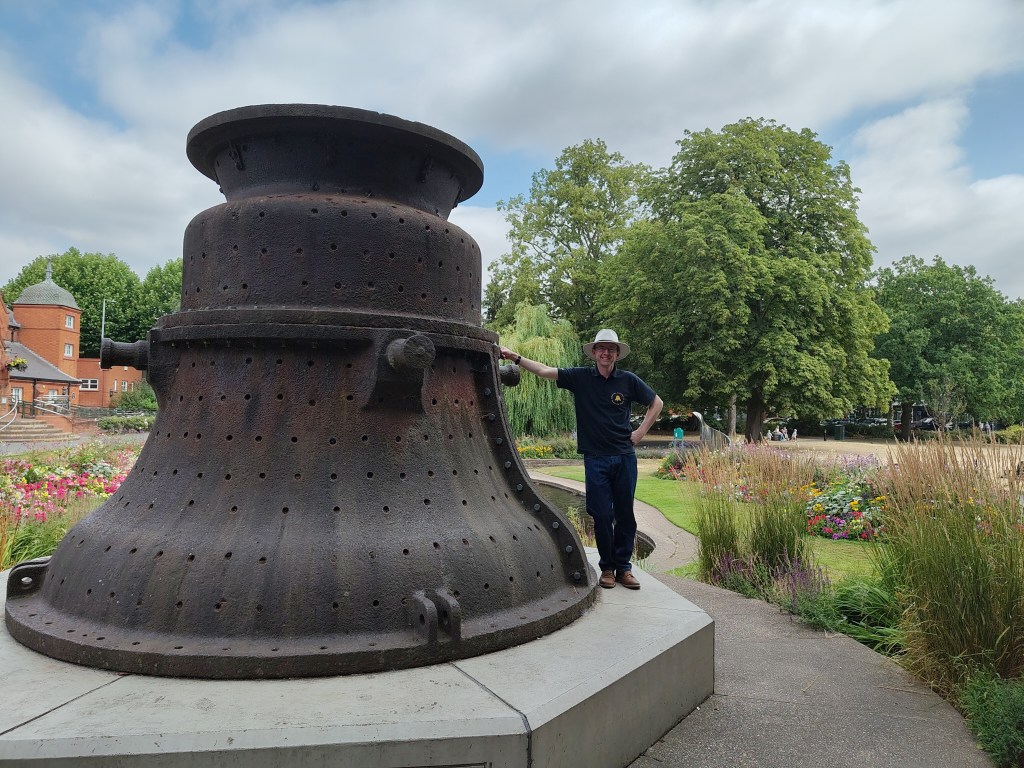
There was one more bell related installation to discover in the park. The impressively huge bell casing for Great Paul which was cast by Taylor’s in 1881. At 16.75 tonnes it is the largest bell ever to have been cast in the UK and still sits in the south west tower of St Paul’s Cathedral in London. The bell casing or mould now sits surrounded by planting and sculptural elements that echo its colour.
This is a story that celebrates the town’s bell making heritage in a much more straightforward way and the numbers are impressive. To make the bell Taylor’s had to extend the foundry and build a third furnace so that they could melt enough metal. It took more than eight hours to melt, just four minutes to pour into the cast iron case, and then six days for the bell to cool in its pit before it could be lifted from the case. The finished bell was too wide for railway wagons and moving it by boat was deemed impractical so two steam traction engines hauled a strongly built tractor, attracting crowds along every stage of the eleven day route. The information board next to the casing includes archive photographs from this extraordinary story. The bell was a real source of pride for town and the reputation of bellfoundry.
Exploring the park really set the scene for the foundry tour because it gave me a sense of how bells fitted into a wider community history, and how they were a local symbol holding a whole range of meanings including remembrance, celebration, hope, resilience and pride.
After the tour, while I was waiting for the bellringers to finish having a go on the Taylor’s own ring of bells, I watched a video in the bellfoundry museum which introduced the work of Charnwood Arts on the Loughborough Bell Festival.
The project was a series of three festivals themed around heritage and music, taking as its starting point the idea that ‘In Loughborough, the bell is more than just a sound; it is a symbol of the town’s industrial heritage and vibrant present-day community.’
In 2023 local artist Mita Rao created a seven foot tall willow bell inspired by Great Paul which travelled from All Saints Church to the Carillon in Queen’s Park on an antique trailer pulled by a steam engine, recalling the journey of Great Paul from Loughborough to London. Other events included heritage displays, creative workshops, history trails and performances. In 2024 a projection, trail and concerts continued to connect heritage with contemporary creativity. A climate vigil, ‘sound the alarm, ring in hope’ provided another way to think about bells in the contemporary world. The final festival is a digital installation ‘Bells, Bridges and Belonging’ which is an interactive timeline through the story of bell making in Loughborough, featuring an evocative soundtrack. Throughout the video there was a strong sense of community, with the bell as a symbol that can bring people together. There was also a sense of the pride felt about the craft of bellmaking and heritage of Loughborough bells that connects the town with not just local and national communities but with different cultures across the world.
It was noticeable that Queen’s Park featured as a hub for many of the events, an open and accessible green space at the heart of the community.
I expected to come away from the Loughborough trip with a sense of the history of the craft of bell making and an understanding the history of the Taylor company. What I got from my walk in the park was something much richer, a sense of community past and present, an awareness of how bells have resonated with the people of the town from World War One to a twenty-first century pandemic, and how they continue to provide a creative impetus. That this collective memory is held in a public park seems fitting.


